Are AI Detectors Accurate? What They Miss
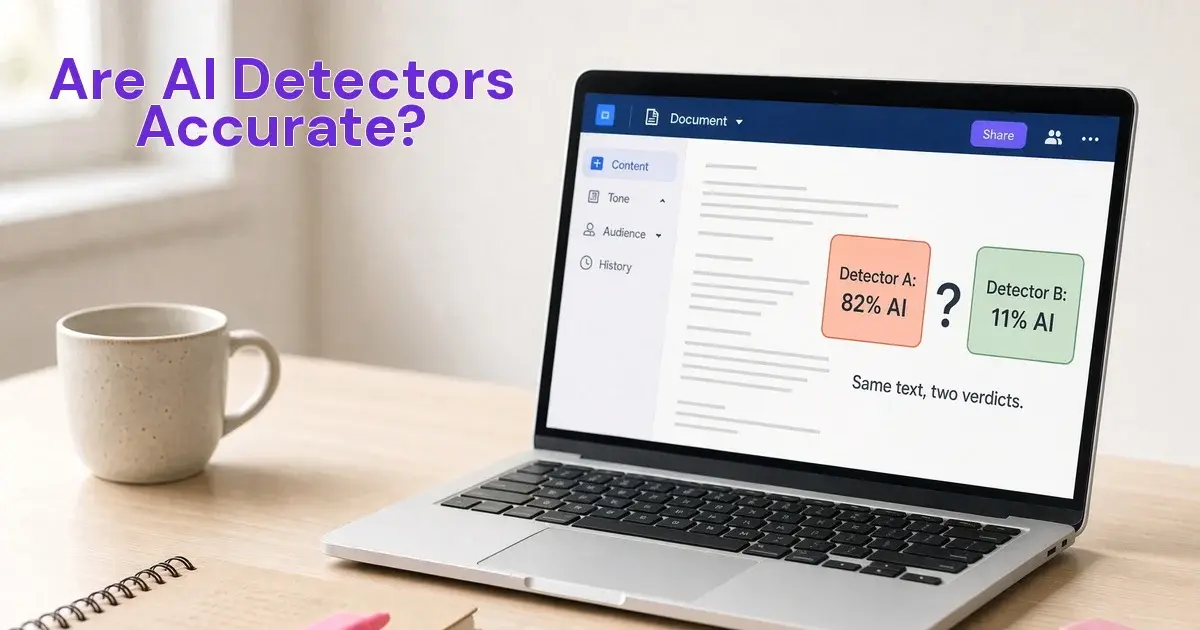
Are AI detectors accurate? Accurate enough to raise a question, never accurate enough to close one. Detectors like GPTZero, Turnitin and Originality.ai estimate how machine-like the wording looks, not who wrote it, so clean human writing can get flagged as AI. A detector can point at something but cannot prove who wrote it, so no honest teacher, editor or manager should treat a score as evidence.
Quick answer: How accurate are AI detectors? In their own tests, the major vendors report about 99 percent accuracy and false positive rates under 1 percent. Outside tests are less flattering. OpenAI retired its own classifier after it caught only 26 percent of AI text and flagged 9 percent of human text, and a Stanford study found seven detectors labeled more than 61 percent of essays by non-native English speakers as AI. Short passages, edited AI drafts and mixed text are where detectors miss most. Treat a score as a reason to look closer, never as proof. If you are wrongly flagged, keep your drafts and version history and offer to explain your work.
That matters because the stakes are real. Students get accused. Freelancers lose clients. Job applicants get screened out. All off the back of a number that was never built to carry that weight.
AI Detector Accuracy by Tool: Claimed vs. Tested
Every major detector publishes a headline number. Here is each one next to what outside testers found. Figures checked November 2026. Detector models change often, so check the date on any number you rely on.
| Detector | What the company reports | What independent tests found |
|---|---|---|
| Turnitin | Under 1% false positives per document (for documents with 20% or more AI writing) and about 4% per highlighted sentence, from 2023 | Most accurate of 14 tools at 76% on 54 documents, with no human text wrongly flagged, but weak on edited AI text (Weber-Wulff et al., 2023) |
| GPTZero | 99.76% accuracy and 0.08% false positives in its February 2026 benchmark | False positives from 0% to 2.38% depending on the type of writing, with more misses on short text (Jabarian and Imas, 2025). A small 2025 study saw 8 of 50 human texts labeled AI |
| Copyleaks | 99.70% accuracy on human text and 99.36% on AI text, English only, September 2026 | Near the top in small 2023 studies. A 2025 benchmark run by rival GPTZero reported a 5.26% false positive rate |
| Originality.ai | 99% or better accuracy, with 0.5% to 2.4% false positives depending on the model | Caught 85% of AI text when set to a 5% false positive rate in the RAID benchmark (2024). Human text was wrongly flagged 2% of the time on Reddit posts and 13% on Wikipedia text |
| OpenAI's classifier | Retired in July 2023 for its "low rate of accuracy" | Caught 26% of AI text and flagged 9% of human text, by OpenAI's own figures |
The pattern is consistent. Vendor tests use long, clean, unedited samples and report near-perfect numbers. Outside tests use messier text and find more misses and more false flags, especially on short passages, edited AI drafts and writing by non-native English speakers. Even a 1 percent false positive rate adds up: Vanderbilt worked out that it could mean about 750 wrongly flagged papers out of the 75,000 it submitted in a year, and turned Turnitin's detector off in 2023.
Are AI Detectors Accurate Enough to Trust?
Short version: no. Are ai detectors accurate in the sense of catching some machine text some of the time? Sure, sometimes. But accuracy that swings wildly depending on the sample is not accuracy you can act on. Tools like GPTZero, Turnitin, and Originality.ai all give confidence scores, and those scores are widely reported to produce false positives on genuine human writing. A confidence percentage sounds official. It is still a probability, not a fact.
The core problem is what these tools actually measure. If you want the mechanics, here is a plain breakdown of how AI detectors work. The short story is below.
Why AI Detectors Get It Wrong
Detectors do not read for meaning, and they have no way to know who sat at the keyboard. Early detectors, including GPTZero at launch, scored two things directly. One is predictability, sometimes called perplexity: how expected each word is given the words around it. The other is rhythm, sometimes called burstiness: how much your sentence lengths vary. Machine text tends to be smooth and even. So detectors treat smooth, even writing as a red flag. Newer detectors use trained models instead (GPTZero says it switched in autumn 2023), but those models still learn from the same surface patterns, so the problem carries over.
See the trap? A human who writes clean, simple, well-organized prose produces the exact pattern a detector is trained to punish. Clear writing is a virtue everywhere except inside these tools, where it reads as suspicious. That is the root cause behind most false positives. The detector is not measuring authorship. It is measuring style, then labeling a style it does not like.
Why False Positives Hit Some Writers Harder
For the published false positive rates from OpenAI, Turnitin and Stanford, and all seven reasons human writing gets flagged, see AI detector false positives.
False positives are not spread evenly. Two groups get flagged more than they should.
- Plain, direct writers. If you were taught to cut filler, keep sentences tight, and stay on point, your work looks statistically "too clean" to a detector. Good habits, bad score.
- Non-native English writers. People writing in a second language often lean on common phrasing, safe vocabulary, and steady sentence shapes. Detectors read that steadiness as machine output. In a Stanford study, seven detectors labeled more than 61 percent of TOEFL essays by non-native English speakers as AI-generated, while scoring US eighth-graders' essays almost perfectly (Liang et al., 2023). It is one of the fairness problems nobody has solved.
- Formulaic formats. Lab reports, legal summaries, technical docs, and templated business writing all follow patterns on purpose. That structure can trip a flag on its own.
So the writers most likely to be wrongly accused are often the ones doing everything right. That alone should make anyone slow down before trusting a score.
Why Edited and Mixed Text Confuses Detectors
Most real writing today is a blend. You draft something yourself, then tidy it. Or you get a rough AI draft and rewrite it in your own words. Or a colleague edits your paragraph. Detectors have no clean way to handle any of this.
When human and machine text mix, the signal gets muddy. A heavily edited AI draft can pass as fully human. A fully human draft that happens to be smooth can fail. The tool cannot tell the difference between "a person wrote this and polished it" and "a machine wrote this and a person polished it." Both look similar under the hood. That is why the same paragraph can score differently on two detectors, or even on the same detector on a different day. If you want to see how far that goes, people routinely make ChatGPT text undetectable with basic editing, which tells you plenty about how firm these scores really are.
What to Do If You Are Wrongly Flagged
Getting flagged feels awful, especially when you know you wrote every word. Do not panic, and do not confess to something you did not do. Build your case instead.
- Keep your drafts. Early messy versions are your best evidence. They show the work forming over time.
- Use version history. Google Docs, Word, and most editors track changes automatically. That timeline is hard to fake and easy to show.
- Save your notes and sources. Outlines, research links, and scribbled plans all prove a real process happened.
- Ask how the tool works. A fair reviewer should admit the score is a probability, not proof. If they will not, point them to the well-documented false positive problem.
- Offer to explain your work. Talking through your own argument in person is something no detector can measure and no AI can fake for you.
You are not disproving a fact. You are showing that the "evidence" was never solid to begin with.
How to Lower the Odds of a False Flag
You cannot control someone else's detector, but you can write in a way that reads as unmistakably human. The goal is natural variation, the thing machine text lacks.
- Mix short sentences with long ones. Let some run. Keep some tight.
- Use contractions, plain connectors, and the odd aside in parentheses.
- Add specific detail from your own experience. A real example is a strong human signal.
- Read it out loud. If it sounds like a person talking, it will read like one.
If you have AI-assisted a draft and want it to sound like you again, our free AI humanizer tool rewrites the flat, even patterns detectors chase, so your writing keeps its meaning while reading naturally. It is free to use, and it is built for exactly this problem.
So, are ai detectors accurate? Accurate enough to raise a question, never accurate enough to close one. Treat any score as a prompt to look closer, not a verdict. AI detector accuracy is too shaky, and the false positives too common, to let a number decide someone's future.
Frequently Asked Questions
Can I trust an AI detector score?
Treat it as a question, not an answer. A score can flag something worth a closer look, but it cannot prove who wrote a piece of text. Given how common false positives are and how easily edited text shifts results, no score should decide a grade, a job, or a reputation by itself. Human judgment and real evidence matter more.
Do AI detectors give false positives?
Yes, and this is one of the biggest problems with them. False positives hit plain, direct writers and non-native English speakers especially hard, since both tend to use steady phrasing and simple structure. Formulaic formats like lab reports and technical docs get flagged too. A false positive means real human writing was labeled as AI, which is why scores should not stand alone.
How reliable are AI detector results?
Not reliably enough to act on alone. AI detectors estimate how machine-like the wording looks, not who wrote it. Vendors report false positive rates under 1 percent in their own tests, but outside tests find more errors: OpenAI's retired classifier flagged 9 percent of human text, and a Stanford study saw seven detectors label more than 61 percent of essays by non-native English speakers as AI. A score is a probability, not proof. See the claimed vs. tested numbers for each detector.
Is a 15% AI detection score bad?
Not on its own. A low score like 15% sits in the range detectors trust least. Since July 2024, Turnitin shows only an asterisk for scores from 1 to 19 percent, with no number and no highlights, because it says false positives are more likely there. On GPTZero, a 15% score is the model's estimate for the whole document, not a sign that 15% of your text is AI. If someone raises a low score with you, ask which tool and setting produced it, and show your drafts and version history. See how accurate AI detectors are.
What do I do if I am wrongly flagged for AI?
Do not admit to something you did not do. Gather proof of your process instead: keep early drafts, show version history from Google Docs or Word, and save your notes and sources. Offer to walk a reviewer through your own argument. Then point out that detector scores are probabilities known to produce false positives, not solid evidence.
Why do AI detectors flag human writing?
Because they reward messy, unpredictable text and punish smooth, even text. If you write clearly, keep sentences tight, and stay organized, your work looks statistically similar to machine output. The detector is not reading meaning. It is measuring patterns, and clear human writing happens to match the patterns it was trained to distrust.
Why do different AI detectors give different scores?
Because each detector is built differently. Tools like GPTZero, Turnitin, Copyleaks and Originality.ai are trained on different data, learn from signals such as predictability (perplexity) and sentence variation (burstiness) in different ways, and set different cutoffs for calling text AI. Some also let you pick a sensitivity level. They update their models over time, so the same passage can score differently across tools, or on the same tool a few months apart. None of them can see who wrote the text, which is why a score is a probability, not proof.