An AI detector is a piece of software that reads a block of text and guesses whether a machine wrote it. That guess comes out as a score or a label, and plenty of people now meet one without asking for it. Teachers run essays through an AI checker. Editors screen freelance drafts. Hiring managers scan cover letters. This page explains what these tools do, how AI detection really works, and why the number on the screen is a probability, not a verdict.
What Is an AI Detector?
An AI detector is a classifier. You feed it writing, and it sorts that writing into rough buckets like "likely human" and "likely AI." Some tools give you a single percentage. Others highlight sentence by sentence. A few show both.
Here is the part people miss. An AI content detector doesn't know who typed the words. It has never seen your draft history, your notes, or your search tabs. It only measures patterns in the text in front of it and compares them to patterns it picked up during training. That's the whole trick, and it explains most of what goes wrong later.
How Do AI Detectors Work?
Most tools lean on a handful of signals. None of them prove authorship. They just correlate, more or less, with machine writing. So let's break down how AI detection actually runs under the hood, in plain English.
Predictability and Perplexity
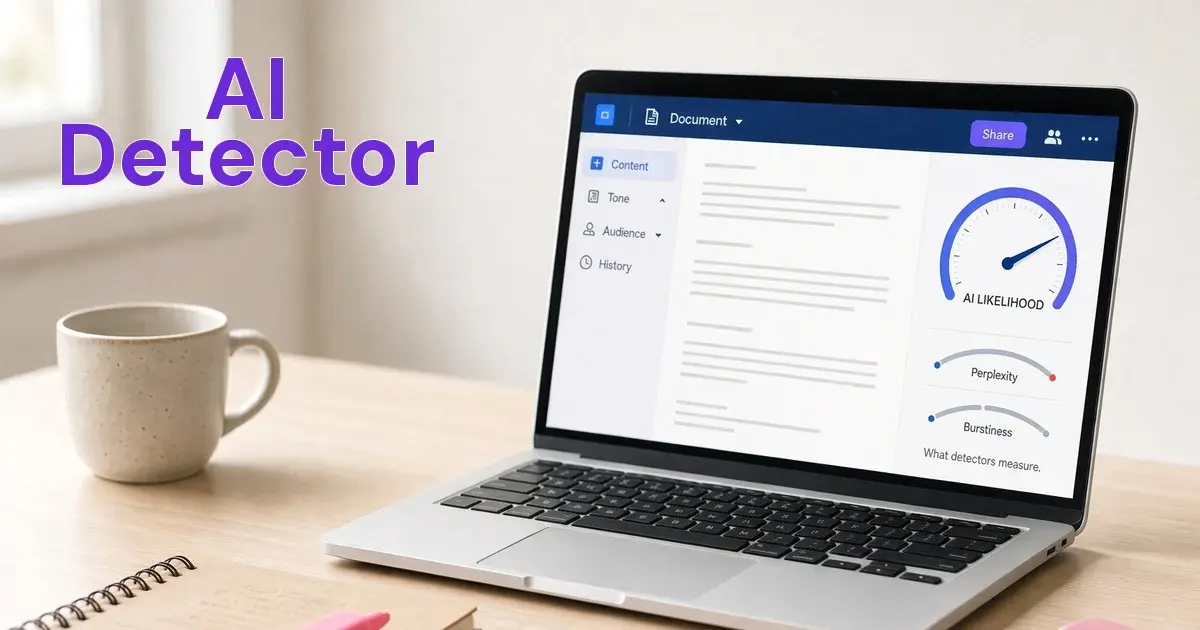
Language models pick the next word that fits best on average. That makes their output smooth and easy to predict. Detectors measure this with something often called perplexity. Low perplexity means the text is very predictable, which reads as more machine-like. High perplexity means the wording surprises the model, which reads as more human. The catch is obvious. Clear, simple, careful human writing is predictable too, so it can score low without any AI involved.
Sentence-Length Variance, or Burstiness
Humans write in bursts. We drop a long, winding sentence and then a short one. Then another short one. Machine drafts tend to hold a steadier rhythm, with sentences that land near the same length again and again. Detectors track this variance. Flat rhythm looks synthetic. Uneven rhythm looks human.
Repeated Patterns and Vocabulary
AI drafts reuse the same connective phrases and the same safe word choices. When a checker sees identical transitions and tidy hedges over and over, it leans toward an AI label. This is also why certain overused words became known as tells in the first place.
Structure and Formatting
Very even paragraphs, neat lists, and a closing that restates everything can nudge a score higher. It isn't proof of anything. It's just a shape that machine writing often takes, so the model treats it as a weak clue and adds it to the pile.
The Main Kinds of Detectors and Where You Meet Them
Tools like GPTZero, Turnitin, and Originality.ai are examples you may have run into. They aren't all built for the same job, and the setting changes what a flag really means.
- Schools. Detection is often bolted onto plagiarism systems. A flag can start an academic honesty review, so the stakes feel high fast.
- Publishers and agencies. Editors screen submitted drafts to protect quality and keep search engines happy.
- Hiring. Recruiters check cover letters and written tests, sometimes with a plain AI detector, sometimes just by eye.
- SEO and marketing teams. Content leads spot-check writers before anything goes live.
Same technology, different rooms. That score means one thing to an editor doing quality control and something much heavier to a student staring at a misconduct email. Knowing which room you're in tells you how much weight the number deserves.
Why an AI Detector Flags Honest Human Writing
False positives are the real problem, and they hit predictable groups hardest. Remember, an AI detector rewards surprise and punishes smoothness. So plain, clean writing takes the hit even when a person wrote every word.
Non-native English writers get flagged more often because they tend to use common words, safe sentence patterns, and careful structure. That's good, clear communication. To a detector, it can read as low perplexity. The same goes for beginners, for technical writers who keep things tight, and for anyone trained to write in a clean, formal style.
These are not rare edge cases. Any honest writer who happens to write plainly can trip a checker, and there is no way for the tool to tell the difference. That's why no serious guide treats a single number as proof. If you want the deeper version, see our piece on whether are AI detectors accurate.
What the Detection Scores Really Mean
A detector score is a probability. When a tool says "80% AI," it isn't saying it caught you. It's saying the patterns in your text resemble patterns it links to machine writing, at that confidence level, on that day, with that model.
Two things follow. First, the same text can score very differently across tools, because each one weighs signals its own way. Run one paragraph through three checkers and you can get three answers. Second, a small edit can swing a score a lot, which tells you the number is soft, not solid.
Treat the result as a hint that invites a closer look, never as evidence on its own. A responsible reviewer uses it to start a conversation, not to end one. If you're curious how people try to bypass AI detection, know that the honest goal is different. You want real human work to read as real human work.
How to Write So You Are Not Wrongly Flagged
You don't need tricks or gimmicks. You need your own voice on the page. These habits help honest writing clear detection without gaming anything, and they make the writing better while they're at it.
- Vary your sentences. Mix long and short. Let the rhythm breathe instead of marching in step.
- Add real detail. A specific example, a name, a number, a small story from your own experience. Machines rarely know your exact facts.
- Cut filler transitions. Drop the stock connectors and hedges that show up in every AI draft.
- Write like you talk. Use contractions and plain words, then read it out loud and fix whatever sounds stiff.
- Keep your drafts. Version history, outlines, and notes are the best answer to any false flag a reviewer throws at you.
Learning the common signs of AI writing also helps you catch them in your own work and fix them before anyone runs a scan.
Clean Up Your Draft the Honest Way
If your own writing keeps getting flagged, you can smooth out the machine-like patterns without faking a thing. Our free AI humanizer tool strips the common tells and restores a natural rhythm, so honest work reads the way you meant it. It's free to use, and it's a faster path than fighting an AI checker line by line.