What Is Perplexity in AI Detection?
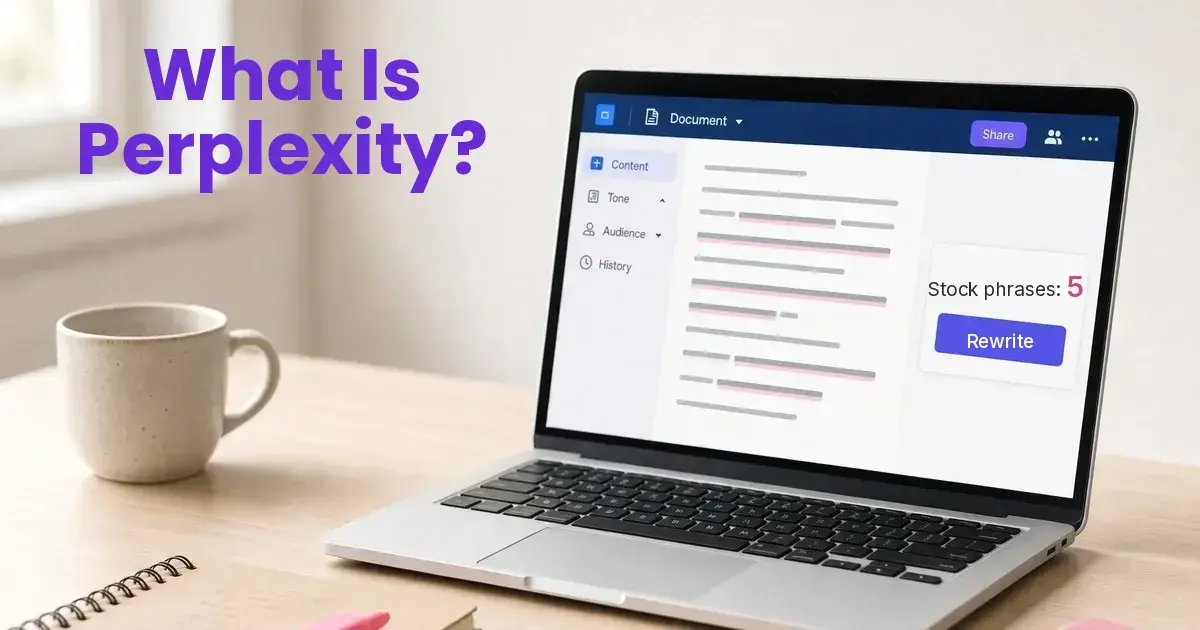
Perplexity is how predictable your wording is to an AI model. Here's what detectors do with it, and a free scanner to check your draft.
- Free scan, no sign up
- Stock phrase check
- Rhythm score
- Runs in your browser
Forgot your code?
Perplexity AI detection works by scoring how predictable text is to a language model: how likely the model would be to choose those exact words in that order. AI text usually scores low, because models pick likely words, while human writing surprises the model more. Some detectors treat low perplexity as a sign of AI, but plain, clear human writing can score low too, so it is never proof alone.
Quick answer: Perplexity AI detection gives a signal, not evidence. Human writing scores low too when it is clear and simple, follows a formula like a cover letter or lab report, or comes from someone writing in a second language. To make a draft less predictable, cut stock openers, use your own specifics, say it the way you would say it, and mix short and long sentences. The scanner above flags stock phrases and scores rhythm; it does not compute a perplexity score.
Paste a draft into the scanner above to find the predictable stock phrases and flat rhythm that make text read as machine-made.
Perplexity in plain English
Imagine a language model reading your sentence one word at a time and guessing the next word before it sees it. If it keeps guessing right, your text has low perplexity: nothing surprised it. If it keeps guessing wrong, your text has high perplexity.
- Low perplexity: "In today's fast-paced world, it is important to stay organized." Every word is the obvious next word.
- Higher perplexity: "My desk looks like a paper recycling plant lost a bet." The model didn't see that coming.
The term comes from language modeling research, where lower perplexity means a model predicts text better. AI detectors flipped it around: if a model finds your text very easy to predict, maybe a model wrote it.
How detectors use perplexity
Early detectors such as GPTZero scored each sentence's perplexity and combined it with burstiness, which is how much that score swings across the document. GPTZero says it moved to a deep learning model in autumn 2023 and now uses these statistics as one indicator among several. The idea still shapes how many detectors work: text that is uniformly predictable looks machine-made. Perplexity is one signal an AI detector weighs, alongside burstiness, repeated vocabulary and structure.
Why human writing gets low perplexity too
- Clear, simple writing. Short, plain sentences are easy to predict. That's good writing, and it can look "AI."
- Formulaic genres. Cover letters, lab reports, legal text and product descriptions follow patterns on purpose.
- Writing in a second language. People writing in a second language often use common, safe phrasing, and research from Stanford found detectors flagged their essays far more often.
- Famous text. Well-known passages are highly predictable to models that trained on them.
That's a big reason detectors produce false positives. More on that in Are AI Detectors Accurate?
How to make your writing less predictable, honestly
- Cut the stock openers. "In today's fast-paced world" and "It's important to note" are as predictable as English gets.
- Use your specifics. Real names, numbers, places and details you know are the least predictable words in any draft.
- Say it the way you would say it. Your own phrasing beats the safest phrasing.
- Vary your sentences. Mix short and long, and don't repeat one structure over and over.
The scanner doesn't compute a perplexity score. It flags the stock words and phrases that drive perplexity down, and its Rhythm score checks sentence variation, so you know what to rewrite.
Frequently Asked Questions
What does perplexity mean in AI detection?
It measures how predictable a text is to a language model. Low perplexity means the model could easily guess the words, which detectors treat as one possible sign of AI writing.
Is low perplexity proof that AI wrote something?
No. Clear, simple and formulaic human writing can have low perplexity too, and so can writing by people working in a second language. It's a signal, not evidence.
What is a good perplexity score?
There's no universal number. Each detector uses its own model and threshold, so scores from different tools can't be compared.
What is the difference between perplexity and burstiness?
Perplexity is how predictable the text is. Burstiness is how much that predictability, and sentence length and structure, vary across the whole piece. See What Is Burstiness in AI Writing?
Does the scanner measure perplexity?
No. It flags the predictable stock phrases, AI words and punctuation that make text read as machine-made, and its Rhythm score checks how much your sentences vary.
Looking for other ideas? See all the ways to use Remove AI Tells.