Words That Give Away AI Writing (2026 List)
Large language models learn from mountains of published text, and they absorb the vocabulary that shows up most in that pile. Ask one for an article and it reaches for the safe, average choice every time. That is why so many words that give away ai writing cluster in the same small set. The words are not wrong. They are just predictable, and predictable is what tips a reader off.
Why AI reaches for the same words
A model picks each word by guessing what usually comes next. The training data rewards the middle of the road, so the output drifts toward vocabulary that sounds formal and finished. A person has quirks. A model has averages.
The result is a house style. The same puffed-up verbs, the same vague praise, and the same stiff transitions show up in a book report and a product page alike. Once you know the pattern, you cannot unsee it. That is both the problem and the fix.
The words that give away AI writing, grouped by type
Most tells fall into four buckets. Learn the buckets and you can spot new offenders on your own, even ones no list has named yet.
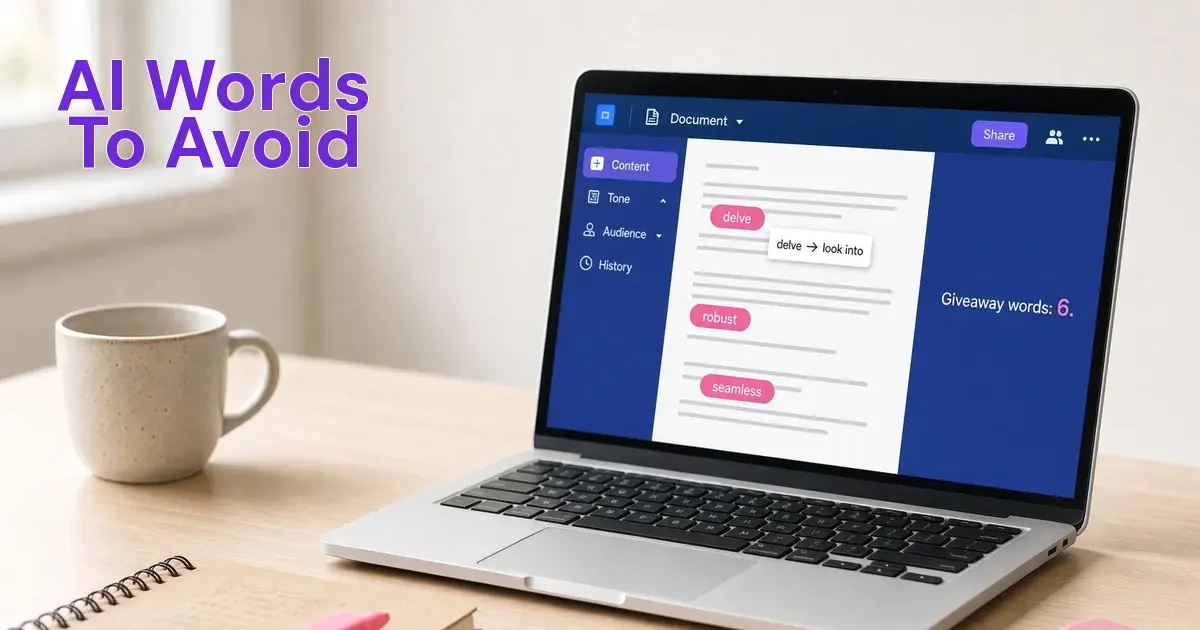
Inflated verbs. These dress up a plain action. Delve, leverage, utilize, foster, harness, navigate, underscore, streamline. A person says use. A model says leverage.
Filler adjectives. These sound impressive and carry almost no meaning. Robust, seamless, comprehensive, cutting-edge, vibrant, pivotal, meticulous. They pad a sentence without adding a single fact.
Abstract nouns. These float above the real thing. Tapestry, realm, landscape, testament, synergy, framework. Watch for phrases like "a rich tapestry of" and "in the realm of."
Corporate transitions. These glue paragraphs together in a stiff, memo-like way. Moreover, furthermore, additionally, in conclusion, it is worth noting, needless to say. Real people almost never open a sentence with furthermore.
The worst offenders and plain replacements
Here is a quick swap sheet. The left column is the tell. The right column is what a person would actually type.
| AI word | Plain replacement |
|---|---|
| delve | look into, dig into |
| leverage | use |
| utilize | use |
| robust | solid, strong |
| seamless | smooth |
| comprehensive | full, complete |
| facilitate | help, make easier |
| navigate | handle, work through |
| foster | build, grow |
| underscore | show, point out |
| tapestry | mix, range |
| realm | area, field |
| moreover | also, and |
| in conclusion | so, to wrap up |
Keep this table near your keyboard for a week. After that you will hear the swaps before you type the tell.
How to catch these words in your own drafts
The words that give away AI writing are easy to find once you know the list. Two habits catch most of them.
First, run a find-and-read pass. Open your find box, type each suspect word one at a time, and look at every hit in context. Do not fix on autopilot. Read the sentence and ask whether a person would really say it that way. Half the time the answer is no.
Second, read the draft aloud. Your ear catches what your eye skips. A stiff verb or an empty adjective sounds off the moment you speak it. If you stumble or cringe, mark that line. For a wider checklist of tells beyond vocabulary, our guide to the signs of AI writing covers structure, punctuation, and phrasing too.
Why swapping words is not enough
Here is the catch. You can replace every flagged word and still sound like a machine. Vocabulary is only one layer. Rhythm is the deeper tell.
AI drafts tend to march. Sentence after sentence lands at the same length, each one balanced and tidy. Human writing swings. A long, winding thought gets followed by three words. That break is what makes prose sound alive.
So fix the beat while you fix the words. Chop a bloated sentence in two. Let a short one stand alone. Cut a transition and just start the next idea. Punctuation matters here as well, and the em dash tell is one of the loudest signals a model left its fingerprints behind. Swap the AI words, then read for pace, and the piece finally sounds like you.
How Remove AI Tells flags these words
You do not have to memorize every offender. Remove AI Tells scans your text and highlights the words that give away AI writing as you work, from inflated verbs to filler adjectives to corporate glue. It suggests plain swaps and smooths the rhythm at the same time, so you fix the vocabulary and the beat in one pass.
Paste a draft, see the tells light up, and clean them in seconds. Try the free AI humanizer tool and watch your writing stop sounding like a template. It is free, and it takes about a minute.
Frequently Asked Questions
Do AI detectors flag specific words?
Most detectors do not flag single words directly. They score patterns like predictability and sentence uniformity. That said, a page stuffed with delve, robust, and seamless raises the odds a detector calls it AI, because those words come with the machine-like patterns detectors measure.
Cleaning the vocabulary helps, but you also need varied rhythm to move the needle.
How do I find AI words in my draft?
Run a find-and-read pass. Type each suspect word into your find box and check every hit in context instead of fixing blindly. Then read the whole draft aloud, since your ear catches stiff phrasing your eye skips.
A scrubber speeds this up by highlighting the tells and suggesting plain replacements as you go, so you spend less time hunting and more time editing.
Is it enough to just swap the words?
No. Word swaps are step one, not the whole job. You can replace every flagged term and still sound robotic if every sentence runs the same length and the structure stays flat.
Fix the rhythm too. Break up long sentences, let short ones stand alone, and cut stiff transitions. Vocabulary plus pace is what makes writing read as human.
What should I use instead of these words?
Swap for the plainest version you would actually say out loud. Leverage becomes use. Robust becomes solid. Seamless becomes smooth. Comprehensive becomes full. Delve becomes look into. Moreover becomes also.
The goal is not a thesaurus swap. It is to sound like a person talking to another person. Simpler almost always wins.
What words give away AI writing?
The usual suspects are inflated verbs like delve, leverage, and utilize, empty adjectives like robust, seamless, and comprehensive, abstract nouns like tapestry and realm, and stiff transitions like moreover and furthermore.
These are not bad words on their own. They stand out because AI uses them far more than any person would. When several show up in one paragraph, the writing reads as machine-made.
Why does ChatGPT use the word delve so often?
Models pick words by predicting what usually comes next, and their training data is full of formal, published prose where delve is common. The safe, average pick wins every time, so delve surfaces far more than it does in normal speech.
A person would say look into or dig into. The model reaches for the fancier option out of habit, which is exactly what makes it a tell.