What Is Burstiness in AI Writing?
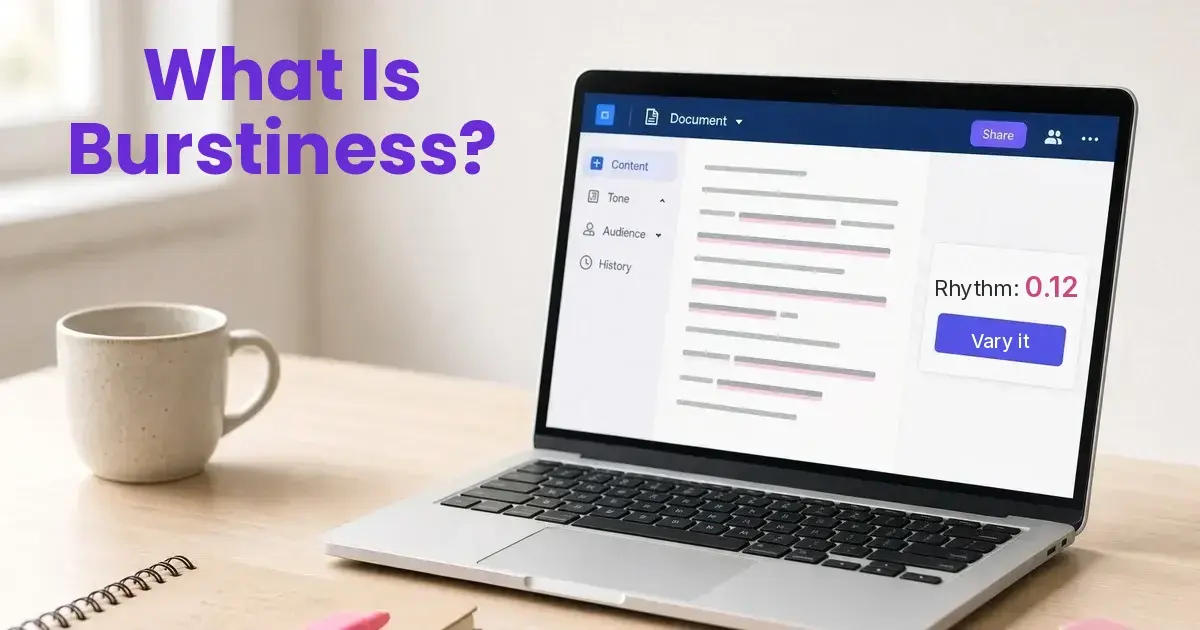
Burstiness is how much your writing varies from sentence to sentence. Paste a draft below and the free scanner scores its rhythm.
- Free rhythm score
- No sign up
- Runs in your browser
- Works on any draft
Forgot your code?
Burstiness in AI writing is how much a text varies from one sentence to the next, in length, structure and how predictable the wording is. People write in bursts: a long, winding sentence, then a short one, then a question. AI-generated text tends to be more even, with sentence after sentence of about the same length and shape. Some AI detectors treat low burstiness as one sign of machine writing.
Quick answer: Low burstiness in AI writing is a style note, not proof. Legal text, technical documentation and writing by people working in a second language can be even too. To add natural variation, read the draft aloud, cut one sentence short, join two short ones, vary the openings, and break the list of three. Paste a draft into the scanner above. Its Rhythm score shows how much your sentence lengths vary: a flat sample scores around 0.1, while mixed writing usually lands well above 0.3.
Hit Try a sample to see a flat, even AI paragraph scored.
Where the term comes from
GPTZero made burstiness a household word when it launched in early 2023, pairing it with perplexity. Perplexity measures how predictable each sentence is to a language model. Burstiness measures how much that predictability, and the sentences themselves, swing across a whole document. GPTZero explains both on its site, and notes that since autumn 2023 it no longer relies on them alone. Its current detector uses a deep learning model, with these statistics as one indicator among several. Other detectors still lean on similar measures. Our guide to how an AI detector works covers the other signals too.
What low and high burstiness look like
| Low burstiness | High burstiness |
|---|---|
| Sentences of nearly the same length | A mix of short, medium and long sentences |
| The same structure repeated: subject, verb, list of three | Varied openings, questions, fragments, asides |
| Every sentence equally smooth and safe | Some sentences plain, some surprising |
| Common in AI drafts, formal reports and templates | Common in natural speech, personal writing and good editing |
Here's a low-burstiness paragraph: "Our team delivers innovative solutions for modern businesses. We leverage data to drive meaningful growth. Our approach ensures seamless results for every client." Three sentences, eight or nine words each, same rhythm. Read it aloud and it drones.
Why AI writing tends to have low burstiness
Language models pick likely next words, one after another, and they're tuned to be clear and consistent. That makes every sentence a safe, mid-length, well-formed sentence. Human writers break patterns without trying. We get excited and run on, then stop short. We start a sentence with "And." That unevenness is what burstiness picks up. Flat rhythm is one of the common signs of AI writing, along with stock words and punctuation habits.
Can burstiness prove something was written by AI?
No. Plenty of human writing is even: legal text, technical documentation, writing by people working in a second language, and anyone taught to write "one idea per sentence." That's one reason detectors flag human writing by mistake. We cover the bigger picture in Are AI Detectors Accurate? Treat a low score as a style note, not a verdict.
How to add natural variation to your writing
- Read it aloud. Where you run out of breath or start to drone, change something.
- Cut one sentence short. A five-word sentence after two long ones resets the ear.
- Combine two small ones. Join related short sentences with "and," "but" or "because."
- Vary the openings. Don't start three sentences in a row with "We" or "The."
- Break the list of three. AI loves threes. Use two, or four, or one strong example.
The scanner's Rhythm number is how much your sentence lengths vary: the lower it is, the more even your sentences. The flat sample above comes in around 0.1, while a paragraph that mixes short and long sentences usually lands well above 0.3. It's a quick check, not a full detector, and it's a good way to spot a paragraph that needs a second pass. For more on this, see Why AI Writing Has a Recognizable Rhythm.
Frequently Asked Questions
What does burstiness mean in AI detection?
It means how much a text varies from sentence to sentence, in length, structure and predictability. Human writing usually varies more. Detectors use low burstiness as one possible sign of AI-generated text.
Is low burstiness bad?
Not always. Some writing, like instructions or legal text, should be even. But in essays, emails and posts, very even sentences read as flat and can look machine-made.
What is the difference between perplexity and burstiness?
Perplexity is how predictable the wording is to a language model. Burstiness is how much that predictability, and sentence length and structure, change across the whole piece. See What Is Perplexity in AI Detection?
Does GPTZero still use burstiness?
According to GPTZero, it moved to a deep learning model in autumn 2023 and no longer relies on perplexity and burstiness alone, though they remain one of its indicators.
How can I check the burstiness of my writing?
Paste it into the scanner above. The Rhythm score measures how much your sentence lengths vary, and the result shows which parts read flat.
Looking for other ideas? See all the ways to use Remove AI Tells.