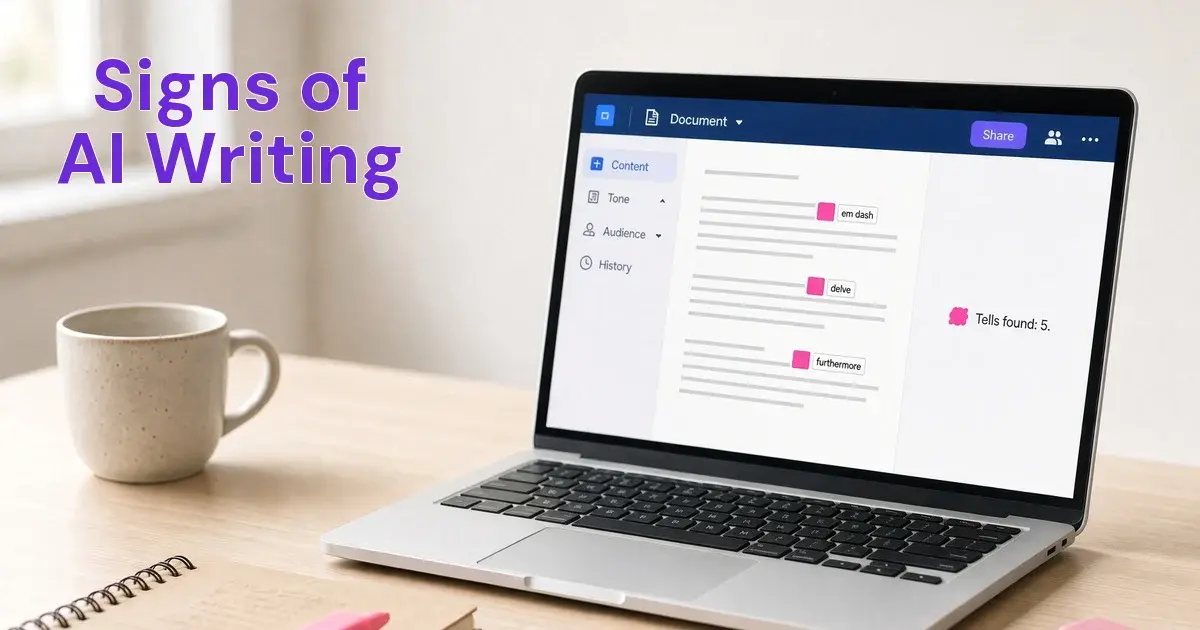
Most AI text isn't wrong. It's just a little too smooth, a little too tidy, and full of the same habits every model reaches for. Once you know the signs of ai writing, you can't unsee them. Below are 16 concrete tells, grouped by type, with a fast fix for each so your draft reads like a person actually wrote it.
Punctuation signs of AI writing
Punctuation is the fastest place to catch a machine. These marks travel with copied text and rarely match how a normal person types in a plain editor.
1. Em dash overuse
Models love the em dash. They drop it everywhere a comma, a period, or a pair of parentheses would do the job just as well. One or two across a whole article is normal. Two or three per paragraph is a loud tell, and it's one of the first things a reader clocks even without knowing why.
Fix: Swap most of them for commas or periods. Read more about the em dash AI tell and why it stands out so much.
2. Curly quotes and fancy punctuation
Copy pasted AI output often carries curly quotes, curly apostrophes, and the single-character ellipsis. Most people typing straight into a form or a CMS produce plain straight quotes instead. When a paragraph is full of typographer's marks that the surrounding text doesn't have, the mismatch gives it away.
Fix: Find and replace curly marks with straight ones. Kill the ellipsis character and use three periods if you really need the pause.
3. Invisible and zero-width characters
Some models slip in zero-width spaces, non-breaking spaces, and other invisible characters you can't see but a detector can read instantly. These are among the sneakiest ai tells because they survive a copy paste and sit there silently in your text, flagging it as machine made.
Fix: Run the text through a cleaner that strips hidden characters, or retype any flagged sentences by hand.
Vocabulary tells and word choice
Word choice is where AI shows its training. It reaches for the same formal vocabulary and the same safe hedges over and over.
4. Giveaway vocabulary
Certain words scream machine: delve, robust, tapestry, leverage, seamless, comprehensive, pivotal, meticulous. No single word proves anything on its own. A cluster of them in one piece is a classic pattern, because a person writing casually almost never stacks that many high-register words together.
Fix: Cut them or swap in plain alternatives. See the full list of words that give away AI writing.
5. Boilerplate transitions
"In conclusion," "furthermore," "moreover," and "it's important to note" are stock connectors models use to sound organized and formal. Real writers rarely reach for them, and almost never three in the same piece. They add length without adding meaning.
Fix: Delete the transition, or replace it with a plain one like "so," "but," or "here's why."
6. Hedging and vague qualifiers
AI hedges to stay safe. You'll see "can be," "often," "may," "in many cases," and "generally" softening almost every claim in the piece. The result reads careful and committed to nothing. A human with an opinion sounds sharper than that.
Fix: Pick a position. Replace the hedge with a direct statement or a specific number you can stand behind.
Rhythm tells: how the text sounds
Read the draft out loud. Machine text has a rhythm problem that's obvious to the ear even when every sentence is technically fine.
7. Flat sentence rhythm
Human writing has burstiness. Long sentences bump against short ones, and the pace jumps around. AI tends to produce sentences of similar length and shape, line after line after line, which reads flat and a little robotic no matter how good the words are.
Fix: Break a long sentence into two. Add a three word sentence. Let the rhythm swing.
8. The "it's not just X, it's Y" construction
This one is everywhere in chatgpt tells. "It's not just a tool, it's a partner." "This isn't about speed, it's about trust." The mirrored setup feels punchy the first time and canned by the third. Once you notice it, you'll see it in half the AI copy you read.
Fix: Rewrite it as a plain statement. Say what the thing is without the setup and the reversal.
9. Symmetrical rule-of-three phrasing
Models love triads: "clear, concise, and correct." "Plan, build, and ship." The rhythm is so balanced it feels rehearsed, and it repeats in list after list until the whole piece sounds like a slogan generator.
Fix: Use two items sometimes, or four. Break the perfect symmetry so the line sounds spoken, not staged.
Structure tells: how the text is built
Zoom out from the words and look at the shape of the page. AI builds documents in a predictable mold.
10. Uniform paragraph length and shape
AI paragraphs often run the same length, three or four sentences each, block after block down the page. Human drafts are lumpier than that. Some paragraphs are a single line. Some ramble on. The evenness itself is a signal.
Fix: Vary it on purpose. Let a paragraph be one sentence when the point is short.
11. Over-structured lists and headings
A short answer chopped into five headings, each with a bolded lead-in and a neat bullet list, is a strong tell. Real people don't format a casual reply like a corporate deck. The scaffolding is doing the thinking, and it shows.
Fix: Flatten it. Turn some lists back into prose and drop the headings the piece doesn't need.
12. Restating the prompt or the question
AI often opens by repeating the question back at you. "Great question. When it comes to knowing how to tell if something is ai written, there are several factors to consider." That echo is one of the clearest ai writing patterns, and it wastes the first sentence saying nothing.
Fix: Cut the restatement. Start with the actual answer.
13. Empty intros and conclusions
The intro warms up for a whole paragraph without landing a point. The conclusion repeats what you just read and tacks on a tidy takeaway. Both are padding that a person short on time would never bother to write.
Fix: Delete the throat clearing. Open on your strongest point and stop when you're actually done.
Other AI tells to watch for
These last signs of ai writing are the hardest to fake your way around, because they're about substance, not surface.
14. Perfectly clean grammar with no voice
Flawless grammar paired with zero personality is itself a tell. No contractions, no fragments, no asides, no jokes, no rough edges. It reads like a product manual instead of a person, and readers feel the absence even if they can't name it.
Fix: Add contractions and a little attitude. A fragment or a quick aside signals a human hand on the keyboard.
15. No specific details or lived examples
This is the biggest tell of all. AI writes about things in general because it wasn't in the room. No names, no real numbers, no small concrete moment that only someone who was there would know to include. It's confident and completely generic.
Fix: Add one specific detail per section. A real example, a date, a price, a thing that happened.
16. Decorative emoji and bold on everything
Emoji bullet points, a checkmark in front of every benefit, and bold text sprinkled across half the sentences is a common look for AI output, especially in social posts and marketing copy. The formatting is trying to sell you before the words do.
Fix: Strip most of the emoji and bold. Keep formatting for the few spots that truly earn it.
How to fix all of these at once
You can hunt these tells down by hand, and it's worth learning to. But when you need a clean draft fast, run it through our free AI humanizer tool. It strips the hidden characters, fixes the punctuation, and flags the stock words for you in seconds.
Want to go deeper? Our AI humanizer guide and our walkthrough on how to make AI writing sound human cover the edits that matter most once the obvious signs of ai writing are already gone.