AI Disclosure for Lawyers: What ABA Opinion 512 and Courts Say
What ABA Formal Opinion 512, federal court rules and state guidance actually say about lawyers using generative AI, and where disclosure comes into it.
- Free scan, no sign up
- Runs in your browser
- Hidden character check
- Keeps your legal meaning
Forgot your code?
AI disclosure for lawyers comes from two directions at once: ethics rules that govern what you tell clients, and court rules that govern what you file. ABA Formal Opinion 512, issued July 29, 2024, says lawyers using generative AI still owe the same duties of competence, confidentiality, communication and reasonable fees. Some courts now require a statement on filings. Others, like the Illinois Supreme Court, say disclosure should not be required in a pleading, so the answer depends on your jurisdiction and your judge.
This article describes what those authorities say. It is not legal advice. Check your own state bar, your court's local rules and each judge's requirements before you rely on any of it.
What ABA Formal Opinion 512 Says
Opinion 512 was the ABA ethics committee's first formal opinion on lawyers' use of generative AI. It does not create a new rule. It walks through the Model Rules lawyers already follow and explains how each one applies when a tool drafts, summarizes or researches.
Competence and verification
Rule 1.1 requires the "legal knowledge, skill, thoroughness and preparation reasonably necessary for the representation." For generative AI, that means understanding what the tool can and cannot do. The opinion warns that these tools "may combine otherwise accurate information in unexpected ways to yield false or inaccurate results," and that a lawyer should not rely on output "uncritically." Before anything goes to a tribunal, the lawyer checks the analysis and the cited authority and fixes what is wrong.
Confidentiality and informed consent
Rule 1.6 keeps client information confidential "unless the client gives informed consent." The opinion recommends getting a client's informed consent before entering client confidences into a generative AI tool. It also says standard consent language buried in an engagement letter is not enough. An actual conversation about the benefits, risks and intended use is what the opinion has in mind.
Communication with the client
Rule 1.4 requires lawyers to "reasonably consult" with clients about how their objectives will be met. The opinion addresses when, and to what extent, a lawyer has to tell a client that generative AI is being used. The ABA's own Real Property, Trust and Estate Law Section summarizes situations that call for disclosure: the client asks, the engagement terms require it, or the tool's output will significantly shape the direction of the representation.
Supervision and fees
Under Rules 5.1 and 5.3, partners and managers should set clear firm policies on permitted use and make sure lawyers and nonlawyer staff are trained. On fees, the ABA's announcement states that "in most circumstances, the lawyer cannot charge a client for learning how to work a GAI tool." Hourly billing still means billing for time actually spent, even when a tool makes the work faster.
AI Disclosure for Lawyers in Court Filings
Court rules are where disclosure gets concrete, and they differ sharply from one court to the next.
The Northern District of Texas adopted Local Civil Rule 7.2(f), effective September 3, 2024. A brief prepared using generative AI "must disclose this fact on the first page under the heading 'Use of Generative Artificial Intelligence.'" If the presiding judge directs it, the filer must identify the specific parts. A party who files a brief without that heading certifies that no part of it was prepared with generative AI. A matching criminal rule, LCrR 47.2(e), took effect the same day.
Individual judges can add their own terms. In the same district, Judge Matthew Kacsmaryk's requirements page says attorneys and pro se litigants must file a certificate attesting either that no portion of any filing will be drafted by generative AI, or that any AI-drafted language will be checked for accuracy by a human using print reporters or traditional legal databases. Judge Brantley Starr's page now says he no longer requires an AI certification and points filers to the local rules instead.
Illinois went the other way. The Illinois Supreme Court's Policy on Artificial Intelligence, effective January 1, 2025, says AI use by attorneys and litigants "is authorized provided it complies with legal and ethical standards" and that "Disclosure of AI use should not be required in a pleading." The same policy says users "must thoroughly review AI-generated content before submitting it in any court proceeding."
So two federal judges in the same district handled it differently, and a state high court rejected filing disclosure outright. That is the practical reason to check the local rules and the judge's page for every matter.
State Bar Guidance Before Opinion 512
State bar guidance can predate the ABA opinion. The Florida Bar's Board of Governors approved Ethics Advisory Opinion 24-1 on January 19, 2024. It suggests getting the affected client's informed consent before using a third-party generative AI program if that use would involve disclosing confidential information. It compares the risks to those of relying on inexperienced nonlawyer assistants.
Your state may have its own opinion, a pending rule comment, or nothing yet. Read the version that governs your license rather than a summary of someone else's.
Questions to Settle Before Client Data Goes Into a Tool
Opinion 512 expects lawyers to look into the vendor, including the "availability and accessibility of . . . legal relief for violations of the vendor agreement." Privilege questions turn on facts and jurisdiction, so bring these to your ethics counsel instead of answering them by assumption:
- Does the tool keep prompts and outputs, and for how long?
- Can the vendor use inputs to train or improve its models?
- Who at the vendor can see what you enter?
- Has the client given informed consent for this use, in a real conversation?
- Who at the firm reviews the output, and is that review recorded in the file?
Where AI Tells Show Up in Legal Drafts
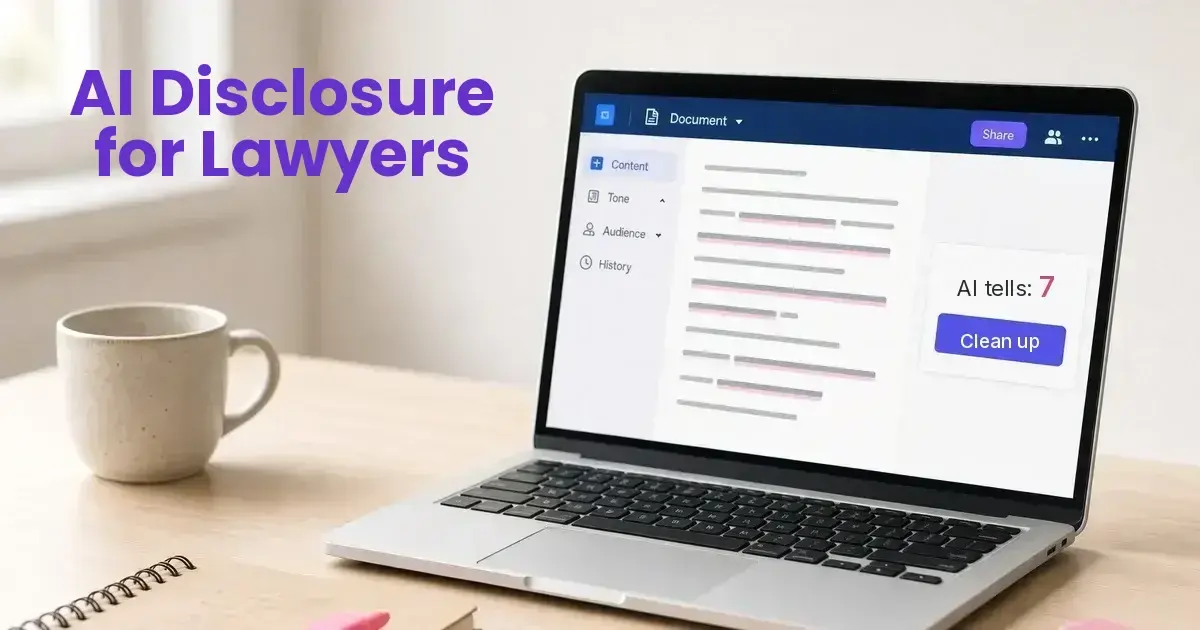
AI disclosure for lawyers covers what the rules require. Quality is a separate problem. A brief or client letter that reads like a model wrote it invites questions about who did the thinking, even when a lawyer checked every citation.
The usual tells are easy to spot once you look. Heavy em dash use is one. Stock vocabulary is another, along with paragraphs that all run the same length and open with the same transitions. Legal text also gets pasted between Word, PDF, email and case management systems, and invisible Unicode characters can ride along. So can hidden instructions buried in documents received from the other side.
No scanner can prove who wrote something, and detectors misfire on careful human writing too, as our piece on AI detector false positives explains. The point is to make the draft sound like the lawyer who signs it. If you want a second look, paste your draft into the free scanner above.
Frequently Asked Questions
Do lawyers have to disclose AI use to clients?
ABA Formal Opinion 512 says it depends on the circumstances under Rule 1.4, and it recommends informed consent before client confidences go into a generative AI tool. The ABA's own section summary points to cases like a client asking or output that will significantly shape the representation. Your state's rules control, so confirm with your bar.
Do courts require lawyers to disclose AI use in filings?
Some do. The Northern District of Texas requires a first-page disclosure on briefs prepared with generative AI, and at least one judge there adds a certificate requirement. The Illinois Supreme Court's policy says disclosure should not be required in a pleading, so check each court and judge.
Can a lawyer bill for time saved by AI?
The ABA's announcement of Opinion 512 says that in most circumstances a lawyer cannot charge a client for learning how to use a generative AI tool. Hourly billing still covers time actually spent. Flat fee and expense questions are fact specific, so read the opinion and your state's fee rules.
Does using AI waive attorney-client privilege?
None of the authorities discussed here answers that in a general way. Entering client confidences into a third-party service raises confidentiality questions under Rule 1.6, and the result turns on the vendor's terms, the jurisdiction and the facts. Ask your ethics counsel about the specific tool.
Where can I read ABA Formal Opinion 512?
The ABA publishes the full opinion and its July 29, 2024 announcement on americanbar.org. Read the opinion itself before you build a firm policy on it, and pair it with any opinion from your own state bar.
Sources
- American Bar Association: ABA issues first ethics guidance on a lawyer's use of AI tools
- ABA Business Law Today: ABA Ethics Opinion on Generative AI Offers Useful Framework
- ABA Real Property, Trust and Estate Law Section: Your Ethical Obligations When Using Generative Artificial Intelligence
- U.S. District Court, N.D. Texas: Special Order 2-98, LR 7.2(f) and LCrR 47.2(e)
- U.S. District Court, N.D. Texas: Judge Matthew J. Kacsmaryk requirements
- U.S. District Court, N.D. Texas: Judge Brantley Starr requirements
- Illinois Supreme Court: Policy on Artificial Intelligence
- The Florida Bar: Board of Governors adopts ethics guidelines for generative AI use